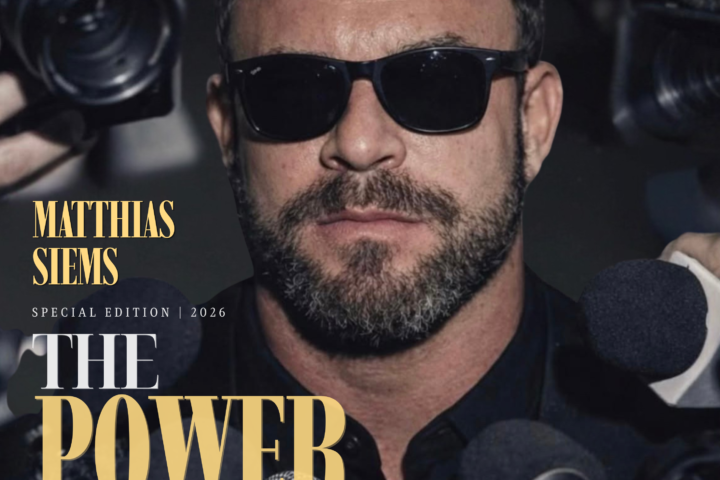




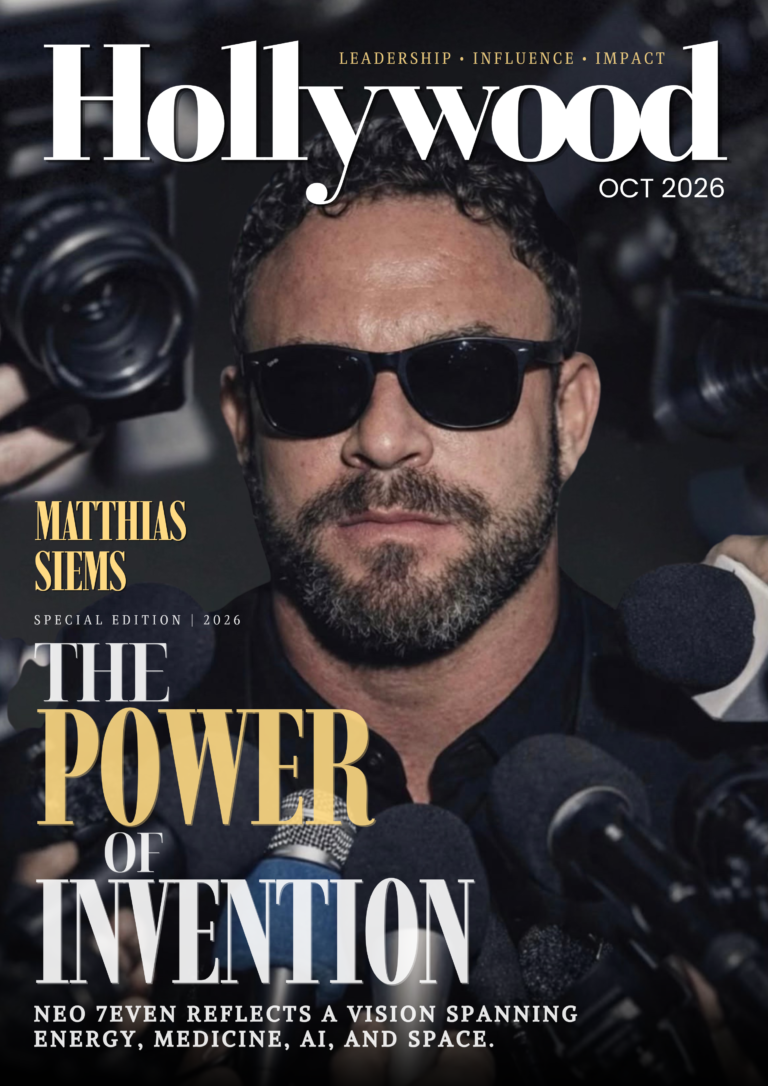
From pioneering experimental energy systems to artificial intelligence, medical breakthroughs and the next generation of inventors, the founder of NEO 7even is pursuing a remarkable vision of scientific discovery, entrepreneurship and global transformation.
Some entrepreneurs build businesses around existing opportunities. Others dedicate their lives to imagining possibilities that the world has yet to discover. Matthias Siems belongs to the latter category.
An inventor, technology investor and entrepreneur, Siems has spent decades exploring unconventional scientific ideas and developing ambitious concepts across energy, medicine, robotics and aerospace. His journey began at just 12 years old, when he reportedly developed his first patent concept, marking the beginning of a lifelong fascination with invention.
Today, at 47, Siems is the founder of NEO 7even, a technology-focused venture capital initiative operating from the United Arab Emirates. His entrepreneurial journey has evolved into an expansive mission: to transform early-stage scientific ideas into commercially viable technologies that can improve lives, create opportunities and challenge conventional limitations.
At the heart of his philosophy is a belief that imagination remains one of humanity’s most powerful resources.
A Mind That Never Stopped Dreaming
Long before establishing himself in the world of investment and technological development, Matthias Siems was fascinated by questions that conventional thinking could not always answer.
An autodidact and unconventional inventor, Siems has reportedly contributed to the development or intellectual property rights of more than 200 inventions spanning medical technology, robotics, energy systems and aerospace.
His work has included concepts involving artificial organs, regenerative medicine, advanced surgical robotics and technologies designed for commercial spaceflight.
Despite his entrepreneurial accomplishments, Siems has never considered himself a conventional businessman.
“I have probably spent more of my life in my imagination than in reality,” he reflects. “Sometimes that makes me difficult to understand. I become completely absorbed in ideas that other people cannot yet see. But imagination is where every great invention begins.”
His personality combines scientific curiosity with an intense dedication to solving problems. For Siems, imagination is not simply a creative exercise. It is the starting point for developing engineering concepts, prototypes and potentially transformative ventures.
While financial success has accompanied his entrepreneurial pursuits, he remains fascinated by something far more fundamental: the extraordinary potential of the human mind.
TAP: Rethinking the Future of Electricity
One of the most ambitious developments associated with Siems is TAP, short for Total Autonomous Power, an experimental electricity-generation technology designed around advanced magnetic-field engineering.
The proposed system aims to introduce a different architecture for distributed power generation, particularly in environments where conventional electrical infrastructure is unavailable, unreliable or economically difficult to establish.
At the center of TAP is a magnetomechanical system incorporating specially engineered permanent magnets, including neodymium and samarium-cobalt materials.
The concept combines precisely configured magnetic interactions, controlled mechanical movement and electromagnetic energy conversion.
Its proposed engineering architecture includes specialized magnetic arrays, low-friction mechanical systems, axial-flux generator configurations, intelligent energy management and advanced power electronics.
The technology is being explored for potential applications across residential infrastructure, industrial operations, remote communities and specialized aerospace environments.
However, proving the proposed autonomous operating characteristics remains a substantial scientific challenge. Permanent magnets can produce forces but are not themselves a continuously replenishing energy source. Any demonstration of sustained net electrical generation without an external energy input would require comprehensive energy measurements and independent replication.
According to Siems, TAP prototypes have undergone extended testing and technical evaluations involving academic and institutional specialists. Independent documentation of testing methods, measured energy balances and certification findings would be necessary to establish the results.
For Siems, the significance of TAP extends beyond its technical ambitions.
“Electricity is not a luxury. Electricity is education, communication, healthcare, security and economic independence. If we can make reliable power accessible to people who have never had it, we can change much more than their energy supply.”
His long-term vision is rooted in the belief that scientific innovation should contribute to broader human progress.
Electricity Where the World Needs It Most
While energy innovation frequently dominates conversations in major financial and industrial centers, Siems is particularly interested in its potential applications in underserved communities.
He envisions compact electricity-generation systems that could eventually support refugee camps, rural medical facilities, isolated villages and emergency-response operations, provided the technology can meet the necessary scientific and engineering requirements.
Across parts of Africa and other developing regions, limited access to electricity continues to affect economic development, education, healthcare and communication.
Without reliable power, communities face difficulties preserving food, refrigerating essential medicines, operating medical equipment and participating in the global digital economy.
During travels through African countries, including Somalia and Sierra Leone, Siems spent time speaking with young people about their ambitions and the challenges facing their communities.
Those conversations helped shape an important element of his philosophy.
“People often assume that the solution is to bring young people from villages into major cities and give them jobs. But what happens to their families when they leave? Their parents, younger siblings and entire communities remain behind.”
Siems believes economic opportunities should be created where people already live.
A rural community equipped with dependable electricity, internet connectivity and access to digital marketplaces could begin developing new sources of income without requiring younger generations to migrate.
Farmers could reach new customers. Entrepreneurs could establish businesses through smartphones. Families could benefit from refrigeration and improved infrastructure. Children could gain greater access to educational resources.
“Sometimes changing the world does not require building another skyscraper. Sometimes it begins with giving a small village electricity and an internet connection.”
For Siems, the ultimate measure of technological success is not only what a system can accomplish, but how meaningfully it can improve people’s lives.
The Tibetan Experience: Connecting Ancient Wisdom With Artificial Intelligence
One of the most unusual chapters in Siems’ life is his account of spending approximately one year living alongside Buddhist monks in Tibet.
His interest went beyond spiritual exploration. Siems wanted to understand how centuries of accumulated knowledge could be preserved, organized and studied using modern artificial intelligence.
He explored the possibility of digitizing historical manuscripts and arranging their contents chronologically, potentially allowing AI systems to recognize recurring patterns in philosophy, human behavior, societal structures and historical events.
The experience strengthened his belief that humanity’s future may benefit from a deeper understanding of its past.
“Humanity is obsessed with predicting the future, but we often forget to understand the past. History contains patterns. Civilizations repeat mistakes, people repeat behaviors, and many of our supposedly new questions have already been asked centuries ago.”
Siems sees artificial intelligence as an opportunity to connect historical wisdom with modern scientific analysis.
He believes that combining ancient knowledge with computational intelligence could reveal relationships that conventional research methods have overlooked.
“We should not only teach artificial intelligence everything we know today. We should also give it access to what humanity knew a thousand years ago.”
His perspective reflects an unusually broad understanding of innovation, one that brings together history, philosophy, science and emerging technology.
The UAE: Building the Next Generation of Inventors
The United Arab Emirates has become central to Siems’ entrepreneurial ambitions.
Through NEO 7even, his technology-focused venture capital platform, Siems is developing an investment model intended to transform original scientific concepts into commercially viable intellectual property.
Unlike traditional venture capital firms that often focus on established startups and proven business models, his proposed approach emphasizes identifying inventions during their earliest stages.
The envisioned development process follows a complete innovation cycle, beginning with an original idea and progressing through scientific assessment, financing, prototype development, independent testing, certification, commercialization and strategic exit opportunities.
The model emphasizes cooperation between universities, research institutions, engineers, investors and aspiring inventors.
One particularly ambitious component involves engaging talented young people between the ages of 14 and 18, creating opportunities for them to contribute original ideas and scientific perspectives.
The long-term objective is to establish a technology-development ecosystem where innovations originating in the UAE can generate intellectual property, engineering expertise, commercial companies and sustainable employment.
Ideas from the UAE. Developed in the UAE. Creating opportunities for the UAE.
Siems sees this initiative as a contribution to the Emirates’ continued development as an international center for advanced technology and scientific entrepreneurship.
“We don’t need every young inventor to become a businessman. We need to give brilliant minds access to engineers, laboratories, capital and experienced people who know how to turn an idea into something real.”
For Siems, empowering young innovators is not merely a business strategy. It is an investment in the future of scientific progress.
Why the Next Generation May Be Smarter Than Us
As artificial intelligence continues reshaping industries, Siems holds an optimistic perspective on its potential influence on younger generations.
While some executives express concern about AI replacing human capabilities, he believes the technology could accelerate intellectual development and empower a new generation of entrepreneurs.
“I’m convinced that the next generation will be faster and better informed than we were. They have access to knowledge that previous generations spent decades trying to acquire.”
He believes this transformation requires a fundamental shift in traditional leadership.
Conventional executive structures built around centralized authority, information control and hierarchical decision-making may increasingly give way to collaborative environments where talented individuals receive the resources and support needed to achieve extraordinary results.
“Leadership is no longer about being the smartest person in the room. It’s about making sure the smartest people in the room have everything they need to succeed.”
Siems increasingly views his own role as that of a mentor, technology investor and strategic facilitator.
Rather than controlling the ideas of younger innovators, he wants to provide the infrastructure, capital and expertise required to help them realize their potential.
Beyond Energy: Medicine, Robotics and Space Tourism
Although TAP represents a major focus of his current work, Siems’ scientific interests extend into several emerging industries.
His portfolio of inventions and development concepts includes artificial organs, stem-cell technologies, regenerative medicine and advanced surgical robotics.
Another area attracting his attention is the rapidly developing commercial space-tourism industry.
Among his aerospace-related concepts are specialized cosmetic and personal-care technologies for space travelers, designed around the unique environmental challenges associated with spaceflight.
Microgravity, altered fluid distribution, confined cabin conditions and unusual atmospheric environments create requirements for personal-care products that differ from those encountered on Earth.
Siems sees the emerging space-tourism market as an opportunity to develop specialized technologies combining human physiology, materials science and premium consumer innovation.
Across these different sectors, his approach follows a consistent principle: identify problems that conventional industries have not fully addressed and explore whether scientific innovation can produce entirely new solutions.
Success, Wealth and the Freedom to Think Differently
At 47, Matthias Siems has developed an entrepreneurial identity centered on technological innovation, intellectual property and long-term investment.
His business interests are associated with an estimated enterprise valuation of approximately US$2 billion, which, according to Siems, has been assessed and attested to by one of the Big Four auditing firms in the United States.
The reported valuation represents a significant financial dimension of his entrepreneurial activities. However, Siems is quick to distinguish the value of business interests from the deeper personal fulfillment he finds in scientific discovery.
“Money is important because it gives you the freedom to develop ideas that may take years before anyone understands their potential. But the real achievement is when something you imagined becomes useful to another human being.”
His lifestyle reflects the contrasting dimensions of his personality.
Based in Dubai with his Syrian-Swedish fiancée, Siems appreciates the international character of the Emirates, the elegance of Geneva and the creative energy of Los Angeles.
He enjoys beautiful automobiles, architecture, travel and the occasional indulgence in luxury.
Yet those who know him describe a man who can become far more excited about discussing an unusual scientific theory than acquiring an expensive possession.
Beyond his professional pursuits, his private life offers moments of companionship, shared experiences and simplicity away from laboratories, investment negotiations and ambitious technological projects.
For Siems, financial independence is ultimately valuable because it creates the freedom to think differently, explore scientific possibilities and support ideas that may take years to become reality.
A Dreamer With a Mission
Perhaps the defining characteristic of Matthias Siems is his refusal to view conventional limitations as the final answer.
He understands that ambitious inventions must withstand scientific scrutiny, engineering validation and the practical realities of commercialization.
Yet he remains convinced that meaningful progress begins with the willingness to ask questions others may dismiss.
His work spans dramatically different environments, from advanced engineering laboratories in the Gulf to historical manuscripts in Tibetan monasteries, emerging aerospace technologies and remote African communities where access to basic infrastructure remains limited.
The connecting principle is an expansive interpretation of innovation.
Technology, in his view, should not be measured solely by the capital it attracts or the financial valuation it achieves. Its ultimate value lies in the opportunities it creates and the lives it has the potential to improve.
“I don’t believe my purpose is to become the richest person in the room. I want to sit in a room with young people who have ideas far greater than mine and help them build something extraordinary.”
As Siems continues developing his technological ventures and supporting new generations of scientific thinkers, his ambitions remain focused on a future where imagination, entrepreneurship and human potential can develop together.
For Matthias Siems, the future is not simply something to predict.
It is something to invent.
Adam Smith is an accomplished individual who serves as an chief contributor at Healthify Magazine, a leading publication dedicated to promoting health and wellness. With a passion for empowering individuals to live healthier lives, Adam brings a wealth of knowledge and expertise to his role.